
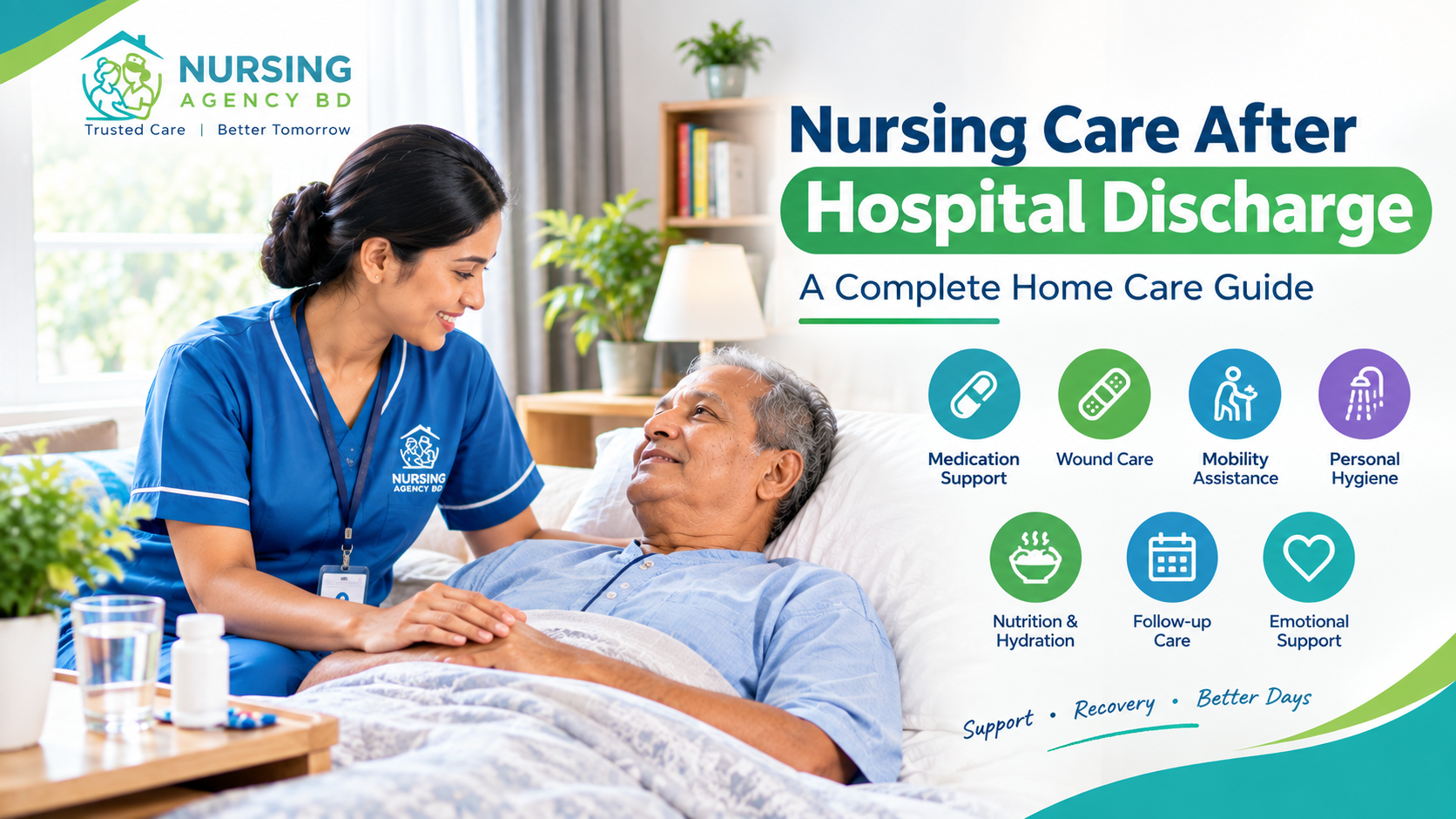
Leaving the hospital is an important step in a patient’s recovery, but going home does not always mean that medical and nursing needs are finished. Many patients still need help with medication routines, wound care, hygiene, nutrition, mobility, follow-up appointments, and everyday activities.
For families, the first few days after discharge can sometimes be challenging. A patient may be weak, have limited movement, need assistance getting out of bed, or require regular monitoring and support.
Proper nursing care after hospital discharge can make the transition from hospital to home more organized and comfortable while helping families manage the patient’s daily care safely.
This guide explains what families should consider after a patient returns home, what type of support may be required, and when professional home nursing care may be appropriate.
What Is Nursing Care After Hospital Discharge?
Nursing care after hospital discharge refers to the care and support a patient may need after leaving a hospital and continuing recovery at home.
The exact care depends on the patient’s condition, treatment plan, age, mobility, and instructions provided by the treating healthcare team.
Depending on the situation, home care may involve:
- Medication support
- Wound and dressing care
- Personal hygiene
- Assistance with bathing and changing clothes
- Feeding and hydration support
- Mobility assistance
- Safe transfer from bed to chair
- Monitoring changes in the patient’s condition
- Support with prescribed exercises
- Follow-up appointment coordination
- Assistance with daily activities
- Emotional and practical support
Some patients may only need help for a few days, while others may require longer-term nursing or caregiver assistance.
Why Is the Period After Hospital Discharge Important?
The transition from hospital care to home care can involve many changes.
In a hospital, nurses and other healthcare professionals are available throughout the day. At home, family members often become responsible for organizing medications, meals, hygiene, mobility, appointments, and other daily needs.
A patient may also feel tired or weak after hospitalization.
Common challenges can include:
- Difficulty walking or standing
- Needing assistance with personal care
- Managing several medications
- Caring for a wound or dressing
- Difficulty preparing meals
- Reduced appetite
- Confusion about the home-care routine
- Fear of falling
- Difficulty sleeping or resting comfortably
- Emotional stress after hospitalization
A clear home-care routine can help families organize these responsibilities.
1. Review the Hospital Discharge Instructions
Before starting the home-care routine, carefully review the discharge instructions provided by the hospital or treating doctor.
Make sure the family understands:
- Which medications have been prescribed
- How and when medications should be taken
- Whether any dressing or wound care is required
- Which activities should be avoided
- Whether movement or walking is restricted
- Whether exercises have been recommended
- When the next follow-up appointment is scheduled
- Whether any tests are required
- Which symptoms require medical attention
If something in the discharge instructions is unclear, contact the appropriate healthcare professional rather than guessing.
A written checklist can be useful, particularly when several family members are sharing responsibility.
2. Organize the Patient’s Medication Routine
Medication management is one of the most important responsibilities after discharge.
Patients may return home with several medicines that have different schedules. Older adults may also have difficulty remembering medication times.
Families can make the routine easier by keeping a written medication schedule containing:
| Information | Example |
|---|---|
| Medicine name | As prescribed |
| Dose | As prescribed |
| Time | Morning / afternoon / night |
| Frequency | As directed |
| Special instructions | Before or after food, if prescribed |
Do not change the dose, stop a prescribed medicine, or add another medicine simply because the patient appears to feel better.
If the patient has difficulty swallowing medication, experiences an unexpected reaction, or misses doses repeatedly, ask the treating healthcare professional what to do.
3. Take Care of Wounds and Dressings
Some patients return home with surgical wounds, dressings, drains, or other areas requiring continued care.
The family should follow the specific instructions given by the healthcare team.
Depending on the patient’s situation, wound care may involve:
- Keeping the area clean according to instructions
- Changing dressings as instructed
- Washing hands before and after care
- Avoiding unnecessary touching of the wound
- Keeping required supplies organized
- Watching for changes around the wound
Changes such as increasing redness, swelling, unusual discharge, worsening pain, or other concerning symptoms should be discussed with the appropriate healthcare professional.
Patients with complex wounds may require professional nursing assistance at home.
For families who need ongoing post-operative support, see our guide to post-operative nursing care at home.
4. Maintain Personal Hygiene
Patients who are weak or have limited mobility may need help with everyday hygiene.
Depending on their ability, assistance may include:
- Bathing
- Washing the face and hands
- Oral hygiene
- Hair care
- Changing clothes
- Changing bed sheets
- Toileting
- Cleaning after using the toilet
- Maintaining clean and dry skin
Personal hygiene is not only about cleanliness. It can also help the patient feel more comfortable and maintain dignity during recovery.
Always encourage the patient to do whatever they can safely manage themselves rather than taking over every activity.
5. Help the Patient Move Safely
After hospitalization, some patients may have reduced strength or balance.
Moving from a bed to a chair, standing up, or walking to the bathroom may therefore require assistance.
Before helping a patient move:
- Keep the walking area clear
- Remove loose objects from the floor
- Make sure commonly used items are within easy reach
- Use prescribed mobility equipment correctly
- Avoid rushing the patient
- Ask for professional guidance when movement is restricted
Do not force a patient to walk or exercise beyond the limits provided by their healthcare team.
Patients recovering from surgery, injury, stroke, or prolonged hospitalization may benefit from professional rehabilitation support.
You can learn more about home physiotherapy services in Dhaka if physiotherapy has been recommended.
6. Make the Home Safer
A patient’s home environment may need to be adjusted after hospital discharge.
This is particularly important when the patient has weakness, balance problems, reduced vision, or difficulty walking.
Simple changes may include:
- Keeping floors free of clutter
- Removing loose rugs where they create a tripping risk
- Keeping frequently used items nearby
- Providing adequate lighting
- Keeping the bathroom accessible
- Making sure the patient’s bed is positioned safely
- Keeping emergency contact information available
- Ensuring mobility aids are used correctly
The goal is to make everyday movement easier without creating unnecessary obstacles.
7. Provide Appropriate Food and Fluids
Patients may have different dietary requirements after hospitalization.
Some may have specific instructions related to their medical condition, surgery, medications, or recovery plan.
Families should follow the dietary advice given by the patient’s healthcare team.
Depending on the patient’s condition, family members may need to assist with:
- Preparing suitable meals
- Serving food
- Encouraging appropriate fluid intake
- Helping a weak patient eat
- Keeping track of dietary instructions
If the patient has difficulty swallowing, repeated vomiting, severe loss of appetite, or other concerning problems with eating or drinking, seek appropriate medical advice.
8. Encourage Rest Without Keeping the Patient Completely Inactive
Rest is often important during recovery, but the appropriate amount of activity depends on the patient’s condition.
Some patients may need significant rest. Others may be encouraged to gradually increase movement.
Follow the activity instructions given by the treating healthcare professional.
A suitable routine may include:
Morning:
Personal hygiene → breakfast → prescribed medication → appropriate activity or exercise
Afternoon:
Lunch → rest → light activity if permitted
Evening:
Personal care → dinner → prescribed medication → comfortable rest
The routine should be adjusted according to the patient’s condition and healthcare instructions.
9. Keep Track of Changes in the Patient’s Condition
Family members and caregivers should pay attention to changes in the patient’s condition.
Useful observations may include:
- Changes in alertness
- Increased weakness
- Changes in mobility
- Changes around a wound
- Difficulty eating or drinking
- New or worsening pain
- Changes in breathing
- Changes in behavior
- Problems taking medication
- Difficulty performing normal activities
Keeping a simple daily record can make it easier to explain changes to the patient’s doctor or nurse.
However, a home record should not replace professional medical evaluation when a patient develops concerning symptoms.
10. Keep Follow-Up Appointments Organized
Hospital discharge is often followed by one or more appointments.
These appointments may involve:
- Reviewing recovery
- Checking a surgical wound
- Reviewing medication
- Removing sutures or dressings when appropriate
- Assessing mobility
- Reviewing test results
- Adjusting treatment
- Planning further rehabilitation
Write down appointment dates and keep relevant medical documents together.
If the patient has difficulty travelling because of limited mobility, families may also consider whether a doctor home visit service is appropriate and available for the patient’s situation.
11. Give the Patient Emotional Support
Physical recovery is only one part of returning home after hospitalization.
A patient may feel:
- Tired
- Frustrated
- Dependent on others
- Worried about their recovery
- Afraid of becoming ill again
- Lonely
- Irritated by restrictions on normal activities
Family members can help by listening, communicating calmly, and involving the patient in decisions about their daily routine whenever possible.
Small things—such as helping the patient stay connected with family members or maintaining familiar routines—can make home recovery more comfortable.
12. Know When Family Care May Not Be Enough
Family members can provide valuable support, but caring for a recovering patient can become difficult when the patient needs assistance throughout the day or requires specific nursing skills.
Professional home nursing may be worth considering when a patient needs help with areas such as:
- Regular nursing care
- Wound or dressing care
- Personal hygiene
- Mobility assistance
- Medication support
- Post-operative care
- Care for a bedridden patient
- Ongoing elderly care
- Monitoring and documentation
- Assistance with complex daily care needs
You can learn more about home nursing care in Bangladesh and the types of support that may be available.
Nurse vs Caregiver: Which Type of Support Does a Patient Need?
A nurse and a caregiver can both support patients at home, but their responsibilities are not identical.
A home nurse may provide:
- Nursing care
- Clinical observations
- Wound and dressing support when appropriate
- Medication-related support within their professional role
- Post-operative nursing care
- Assistance with certain patient-care procedures
- Coordination with the patient’s healthcare team when needed
A caregiver may mainly help with:
- Personal hygiene
- Feeding
- Companionship
- Basic mobility assistance
- Household support related to the patient’s care
- Daily activities
- General supervision
The appropriate choice depends on the patient’s needs.
For patients who mainly require assistance with daily living, a caregiver service in Dhaka may be suitable.
For patients who require nursing responsibilities, professional nursing support may be more appropriate.
How Long Does a Patient Need Care After Hospital Discharge?
There is no single timeframe that applies to every patient.
The required duration can depend on:
- The reason for hospitalization
- Type of surgery or treatment
- Age
- Mobility
- Existing health conditions
- Ability to perform daily activities
- Wound-care requirements
- Family availability
- Doctor’s instructions
- Progress during recovery
Some people may need help for only a few days, while others may require weeks or longer.
The care plan should be adjusted as the patient’s condition changes.
A Simple Daily Home Care Checklist
Families can use the following checklist to organize daily care.
Morning
- ☐ Help with personal hygiene
- ☐ Change clothes or bedding if needed
- ☐ Provide breakfast according to the care plan
- ☐ Follow the prescribed medication schedule
- ☐ Assist with safe movement if permitted
- ☐ Check for any new concerns
Afternoon
- ☐ Provide lunch
- ☐ Support appropriate fluid intake
- ☐ Assist with personal care if needed
- ☐ Encourage permitted activity
- ☐ Allow adequate rest
- ☐ Record important changes
Evening
- ☐ Assist with hygiene
- ☐ Provide dinner
- ☐ Follow the prescribed medication routine
- ☐ Prepare a comfortable sleeping environment
- ☐ Make sure essential items are within reach
Before Bed
- ☐ Ensure the patient is positioned comfortably
- ☐ Keep the surrounding area safe
- ☐ Check that necessary items are accessible
- ☐ Review the next day’s appointments or care requirements
This checklist should be adapted to the patient’s individual instructions.
When Should You Contact a Doctor?
Families should not try to manage every new symptom themselves.
Contact the patient’s healthcare provider when there is a significant or unexpected change in the patient’s condition.
Depending on the patient’s circumstances, concerning changes may include:
- New or worsening breathing difficulty
- Severe or worsening pain
- Significant changes in alertness
- New confusion
- Fainting
- Persistent vomiting
- Significant difficulty eating or drinking
- Concerning changes around a wound
- Sudden deterioration in mobility
- Other symptoms that the hospital specifically instructed the family to report
For an emergency or potentially life-threatening situation, seek emergency medical assistance rather than waiting for a routine home-care visit.
How to Prepare the Home Before the Patient Arrives
Preparing the home before discharge can make the transition easier.
Prepare the patient’s sleeping area
Keep the bed in a convenient location with enough space for safe movement around it.
Organize medicines
Keep prescribed medicines together and maintain a clear schedule.
Prepare hygiene supplies
Keep clothing, towels, toiletries, and other necessary items accessible.
Clear walking paths
Remove unnecessary furniture, clutter, cables, and other obstacles.
Organize medical documents
Keep discharge papers, prescriptions, test reports, and appointment information together.
Arrange assistance
If the patient needs more support than family members can safely provide, arrange professional nursing or caregiver assistance before the patient returns home when possible.
Post-Hospital Care for Elderly Patients
Older adults may require additional support after hospitalization because weakness or reduced mobility can make everyday activities more difficult.
They may need help with:
- Bathing
- Dressing
- Eating
- Walking
- Getting in and out of bed
- Taking medications according to instructions
- Attending follow-up appointments
- Maintaining a safe home environment
Families caring for an older adult can also explore our elder care services in Dhaka for additional support.
The level of assistance should be based on the person’s actual needs rather than age alone.
Post-Hospital Care for Bedridden Patients
Patients who spend most of their time in bed may require more extensive daily assistance.
Care may include:
- Regular repositioning according to the care plan
- Personal hygiene
- Bedding changes
- Feeding assistance
- Mobility support
- Skin observation
- Medication support
- Emotional companionship
Families should pay particular attention to comfort, cleanliness, safe positioning, and changes in the patient’s condition.
For a more detailed guide, read How to Care for a Bedridden Patient at Home.
When Should You Consider a Home Nurse?
A professional home nurse may be appropriate when a patient’s care needs go beyond what family members can comfortably and safely manage.
You may consider professional support when:
- The patient requires regular nursing care
- Family members are unavailable for long periods
- The patient has limited mobility
- The patient needs post-operative care
- Wound care is required
- The patient is bedridden
- An older adult requires ongoing assistance
- Multiple daily care tasks have become difficult to manage
- The family needs professional guidance for the patient’s home-care routine
Professional home care can also give family members more time to focus on emotional support and other responsibilities.
How to Choose Home Nursing Care After Hospital Discharge
Before arranging professional care, families should clearly understand what the patient actually needs.
Consider the following:
1. What type of care is required?
Determine whether the patient needs nursing care, caregiver assistance, physiotherapy, doctor consultation, or a combination of services.
2. How many hours of support are needed?
Some patients may need short visits, while others may require extended or continuous assistance.
3. Does the patient have mobility limitations?
If the patient has difficulty walking or transferring, communicate this clearly when arranging care.
4. Does the patient have post-operative or wound-care needs?
Explain the patient’s requirements so that the appropriate professional support can be arranged.
5. Does the family need temporary or ongoing support?
The care arrangement can be reviewed as the patient becomes more independent.
6. Is the provider transparent about the service?
Families should understand what services are included and what type of professional will provide the care.
Frequently Asked Questions
What is post-discharge nursing care?
Post-discharge nursing care is professional support provided to a patient at home after leaving the hospital. Depending on the patient’s needs, it may include nursing care, medication support, wound care, hygiene assistance, mobility support, and other recovery-related responsibilities.
How long does a patient need home nursing after discharge?
There is no fixed duration. The required period depends on the patient’s condition, recovery progress, mobility, treatment requirements, and instructions from the healthcare team.
Can a caregiver provide post-hospital care?
A caregiver can assist with daily activities such as feeding, hygiene, companionship, and basic mobility support. However, patients requiring professional nursing responsibilities may need a qualified nurse instead.
Is home nursing necessary after every hospital discharge?
No. Some patients can safely recover with support from family members and routine follow-up care. Others may require professional assistance depending on their condition and care requirements.
Can elderly patients receive nursing care at home?
Yes. Home nursing can be arranged for elderly patients when they require appropriate professional support at home. The level of care should depend on their individual needs.
Can a bedridden patient receive nursing care at home?
Yes. Bedridden patients may receive home nursing support depending on their care requirements. Their needs may include hygiene, mobility assistance, medication support, wound care, and other nursing responsibilities.
What should I prepare before bringing a patient home from the hospital?
Prepare the patient’s sleeping area, medicines, hygiene supplies, medical documents, meals or dietary arrangements, mobility aids if prescribed, and any professional support the patient may need.
What should I do if the patient’s condition gets worse after discharge?
Follow the discharge instructions regarding warning signs and contact the patient’s healthcare provider when appropriate. For a medical emergency, seek emergency medical assistance immediately.
Final Thoughts
Going home after hospitalization is an important part of recovery, but patients may still need considerable support during the transition.
A good home-care routine should be based on the patient’s condition and the instructions provided by their healthcare team. Medication routines, hygiene, nutrition, mobility, wound care, follow-up appointments, and emotional support can all become important parts of the recovery process.
When a patient’s needs become difficult for family members to manage safely, professional home nursing or caregiver support can provide additional assistance.
For families in Dhaka looking for professional support, Nursing Agency BD provides home healthcare services that can be arranged according to the patient’s care requirements.
